Friday, March 25, 2016

Primeiro Encontro Internacional de Postcrossing Galego: 16 de abril de 2016

Achégase o gran día! Como sabedes, o día 16 de abril terá lugar o Primeiro Encontro Internacional de Postcrossing en Galicia, en Santa Uxía de Ribeira, e xa aparecemos alistados na páxina oficial de Postcrossing.


Os encontros de Postcrossing son organizados por membros da comunidade porque, como eles mesmos indican na descrición, o intercambio de correspondencia postal é estupendo, pero son as persoas e as conexións creadas as que o fan especial. Entón é normal que se fagan estas reunións ou "quedadas" para coñecer aos individuos detrás dos textos escritos.

Por que se fai este encontro?

O noso encontro é de carácter informal, organizado por min mesma con varios obxectivos:

- quedarmos o máximo número de persoas posibles participantes no proxecto de "Palabras da man ao corazón", tanto profesorado como alumnado, para conversar e intercambiar impresións sobre o seu desenvolvemento durante o seu primeiro ano de andadura e suxerir propostas de mellora.

- facer un exercicio de escritura creativa conxunta de todos os asistentes para responder ás postais que fomos recibindo durante todo o ano e que podedes ver neste apartado do blog.

- coñecer a outros membros de Postcrossing en Galicia.

- dar a coñecer aspectos menos coñecidos da cidade de Ribeira aos nosos visitantes.

Quen pode asistir?

Calquera persoa interesada. Poden asistir tamén nenos/as se están supervisados por un adulto.

Cal será o programa de actividades?

O encontro durará aproximadamente desde as 11.30 da mañá ata as 5 da tarde, e estas serán as actividades que se levarán a cabo:

11:00 - Encontro dos asistentes na entrada do IES número 1 de Ribeira, o centro onde está localizada a nosa sección da EOI. Desde alí faremos grupos para organizar a busca do tesouro da cidade (en inglés) que durará aproximadamente unha hora.

12:30 - Encontro na Praza do Concello e visita a tendas locais para mercar postais (quen o desexe) e a correos para os selos. 

13:30 - Comida no Restaurante A Dorna (agradecería que os/as interesados/as mo comunicárades ao meu correo dpastoriza@eoisantiago.org).

16:00 - Visita á exposición de postais na Biblioteca Municipal de Ribeira e escritura conxunta de postais multilingües (maiormente en inglés, galego e castelán) do encontro.

Que preciso levar? 

Non é preciso traer nada, pero recoméndase traer o seguinte:

- Un dispositivo móbil (smartphone ou tableta) para poder realizar a busca do tesouro (é suficiente con que un membro do grupo o teña). Basta con un por grupo.

- Bolígrafos de cores e/ou pegatinas. A moita xente gústalle a "arte postal", daquela decora as súas postais con debuxos, pegatinas, selos antigos, etc.

- Postais e/ou selos. Aínda que haberá oportunidade de mercalos en Ribeira, tamén se poden traer postais e selos que xa teñamos na casa e nos gustaría enviar.

Esperámosvos!

Thursday, March 24, 2016

Newly Found Letter Written by Walt Whitman for a Dying Soldier

Curiosity... the dictionary defines it as "the desire to learn or know more about something or someone." I don't know if it happens to you, but when I read a text I have this desire to know about the person behind the words, thus the "nosiness" and the wish to know more about  America’s world poet, Walt Whitman, to whom I have devoted the previous blog entry.

Walt Whitman was profoundly affected by the American Civil War (1861-1865). Too old to serve, or lacking the inclination to bear arms, he worked as a psychological nurse to wounded and sick soldiers in the Broadway Hospital in New York. 

In 1863 he moved to Washington DC where he spent several years visiting more than 50 military hospitals, and made many friendships with soldiers, writing letters home for them and corresponding with many of the soldiers themselves after they had recovered and returned to the battlefront. 

I think that, along with the fact that he spent some of his earning as a clerk for the Department of the Interior on gifts for the patients he cared for, say quite a lot about the type of person he was and how he really felt for others.

Therefore, when I read the recent piece of news in the Guardian and Público about the discovery of a letter with a line reading "Written by Walt Whitman", I was dying to know more.

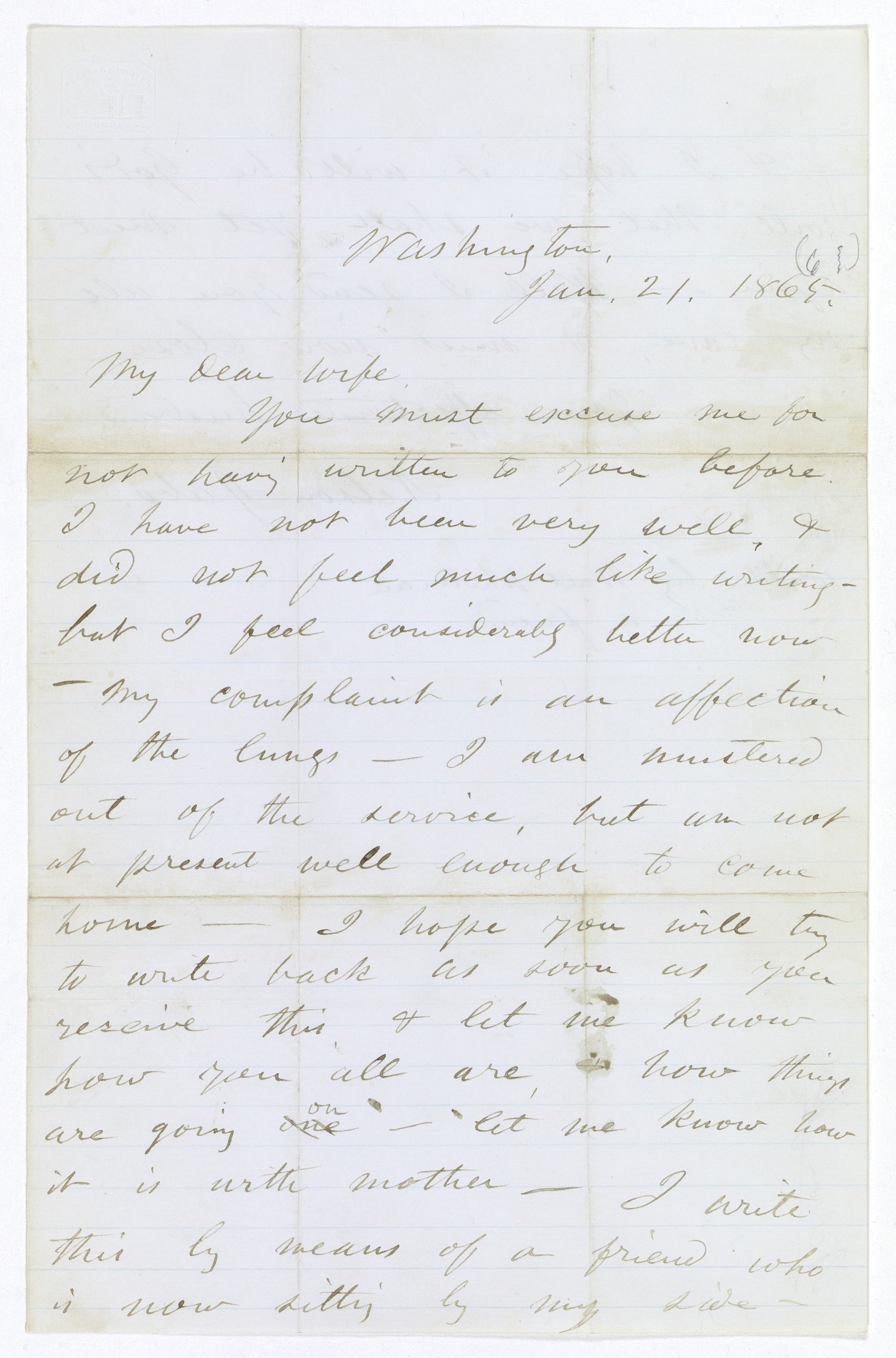
It turns out that Walt Whitman travelled to the fronts of America's Civil War in 1862 to care for his wounded brother and apparently wrote letters for soldiers, but few of them have survived. This one, was found by Catherine Wilson, one of the 60 National Archives volunteers, and it is a letter Whitman penned for Jabo, father of 6, who was dying from tuberculosis and wanted to write to his wife. 

Kenneth Price, Whitman scholar and also responsible for The Walt Whitman archive, thinks Whitman "tried to grasp the gist of what Jabo wanted to convey and then expressed clearly and straightforwardly (...) he tried to channel the sense and spirit of what Jabo wanted to convey".

Below you can see the image of the letter, and you can click on this link to NPR to see a transcription and listen to the story.

As Jackie Budell, a specialist with the National Archives concludes, "You can envision that he  (Whitman) was, in effect, kind of helping them to verbalize maybe what they weren't able to say."

What a gift for us to have writers and poets to help us fully express ourselves and put into words feelings we sometimes fail to convey.

Walt Whitman's Letters

Like most people, I first heard about Walt Whitman in the movie Dead Poets Society (1989), which I watched when I was 12. I remember the powerful scene where John Keating (Robin Williams) quotes some verses of Whitman's poem "O Me! O Life!" and ends up asking his students "What will your verse be?" I also remember trying to find the poem to read it again. Of course I failed to grasp the full meaning at the time, but the power of those final words really echoed in my mind and continue to do so nowadays.


O Me! O Life!
BY WALT WHITMAN


Oh me! Oh life! of the questions of these recurring,
Of the endless trains of the faithless, of cities fill’d with the foolish,
Of myself forever reproaching myself, (for who more foolish than I, and who more faithless?)
Of eyes that vainly crave the light, of the objects mean, of the struggle ever renew’d,
Of the poor results of all, of the plodding and sordid crowds I see around me,
Of the empty and useless years of the rest, with the rest me intertwined,
The question, O me! so sad, recurring—What good amid these, O me, O life?


Answer.

That you are here—that life exists and identity,
That the powerful play goes on, and you may contribute a verse.

Walt Whitman (http://whitmanarchive.org)
If you are interested in yet another dimension of Whitman's writing, you may like to take a look at The Walt Whitman Archive, a comprehensive resource about Whitman's life and work co-directed by Dr Ed Folsom and Dr Kenneth M. Price. There is a very interesting section including Whitman's personal correspondence, both incoming and outgoing. 

There you see the complete Civil War correspondence (1848-1889) and part of the two-way correspondence from the Reconstruction (1867-1876) and post-Reconstruction years (1877-1887), including intimate letters exchanged with his mother, Louisa Van Velsor Whitman or his brother, Thomas Jefferson ("Jeff").

Tuesday, March 15, 2016

O noso blog: Palabras da man ao corazón

Para todos aqueles que visitades o blog por primeira vez, aquí vai un breve minititorial dos contidos do blog e a súa organización.


Thursday, March 3, 2016

Creative Writing: A Portuguese-English Project in the Making

This year, as part of our PFPP (a yearly training plan for teachers we have in our EOI), we have been working on task-based learning. We have had 3 sessions with Sonia Espiñeira Caderno, a Spanish teacher at the EOI in Vigo, which have helped us to gain some insight into the principles underlying task-based learning and some practical considerations about how to design and implement this approach in our classes.

Sonia asked us to work in groups and think about a project that we could actually carry out in our school. I was working with Joseph Ghanime, a Portuguese teacher working in our headquarters in Santiago. We were both trying to find a common interest that would serve as the  basis for this project and a series of tasks that we could take to our classes.

Joseph came up with the topic of migration flows from Galicia and Portugal to North America (the USA and Canada), and thought we could work with this subject to promote creative writing.

Accidentally, that very same week I visited two exhibitions at the Cidade da Cultura which gave us the idea of using photographs as prompts. One of them was the one showing José Suárez's impressive photographs. I really recommend visiting the exhibit, there are beautiful quotations by Eduardo Blanco Amor and the lighting and music chosen, alongside with cameras, letters and personal objects belonging to the photographer really help to round up the visit.

Mariñeiros 08 by José Suárez

The other one was a smaller exhibition about emigration: "Emigrantes: Terras, xentes, emocións", which can be visited until March 4th at the entrance of the Biblioteca e Arquivo de Galicia.

Then, while looking up information about photographers who have documented emigration in Galicia, I of course found Manuel Ferrol. Dolores López, a former student and now good friend of mine, was kind enough to lend me a book she had with photographs where Ferrol captured emigrants on the brink of leavin which are outstanding. Just look at them and you will be moved to tears.

And finally, today I read this article in La Voz de Galicia, describing an initiative by Obra Social Abanca, called "Fálame da emigración", which really ties in nicely with the project we had in mind. 

So keep your eyes peeled, there's a creative writing project in the making and you are going to like it!

Postcrossing Meetup (Received Cards): CHRISTINE from the USA

A little over a month to go for our postcrossing meetup in Ribeira and postcards keep coming! Today we have received a card from the Western coast of the USA, from Tracy, California.


 Christine has sent us a very instructional card, telling us some detailed information about this state, like its nickname ("The Golden State"), state flower (the poppy) and state bird (the valley quail).


She points out that being bilingual is an asset and encourages us to learn English, specially since knowledge of English is often a requisite to get a job.


Thank you, Christine, you will be hearing from us shortly!

Tuesday, March 1, 2016

Letters in Literature: Best Collections of Literary Letters (NPR)

Epistolary fiction is a popular genre where the narrative is told via a series of documents. You have almost certainly read one of these books. Letters are the most common basis for epistolary novels but diary entries are also popular. The word epistolary comes from Latin where epistola means a letter.


I have come across this NPR article which dates back to 2008 but it is still really interesting inasmuch as it gives some examples of correspondence as literature and includes some samples. I must confess I haven't read any of the books they mention but there are other books which include letters and they were quite entertaining reads, such as 84, Charing Cross Road, Dracula, or We Need to Talk about Kevin.

In the past 10 years, there has been a steady stream of epistolary literature. Notable examples include World War Z: An Oral History of the Zombie War by Max Brooks and the one I've just mentioned above, We Need to Talk about Kevin by Lionel Shriver (which we read in our book club a couple of years ago). The Griffin and Sabine series, a love affair told via letters and postcards, by artist Nick Bantock is a trilogy and another example of this form of writing.

They all go on to confirm that letters continue to fascinate us and that the art of writing letters is not fading away in the 21st century.