Sunday, April 24, 2016

Letters in Films: Her

Her is a 2013 American romantic sicence fiction comedy-drama film written, directed and produced by Spike Jonze. It tells the story of Theodore Twombly (Joaquin Phoenix), a man who develops a relationship with Samantha (Scarlett Johansson), an intelligent computer operating system personified through a female voice. 

The film was not very well-received in Spain, in fact I talked about it in class on Thursday and nobody had even heard of it. However, I did enjoy it. I like Joaquin Phoenix (you can't deny his versatility as an actor), the setting (that techno-perfect Los Angeles of the near future), Scarlett Johansson's sexy voice, and above all I love Theodore Twombly.

He is a lonely guy with an unattractive moustache and glasses who wears the high-waisted slacks that have apparently become fashionable for men in this era. He has an entirely unironic job in a company called BeautifulHandwrittenLetters.com in a "creative" office space: Theodore composes special-occasion letters for the tongue-tied, the inarticulate and the illiterate, and his firm's state-of-the-art software will print out authentic-looking handwritten drafts of his dictation. 


The idea that there is a market for such a niche luxury service in the near future fascinates me. It is a profitable one too, since Theodore lives in a spectacular apartment, and his material comfort does not appear to be affected by a nasty, ongoing divorce from Catherine (Rooney Mara).

And finally here's a scene with a moving dialogue about books as a metaphor for relationships.

Letters in Books: Cartas desde el infierno

I am sure we all have memories of Ramón Sampedro (1943-1998), because he was the man fighting for his right to die, and his case was all over the news in Spain back in the 90es; or else because we remember his story told by Alejandro Amenábar in his movie Mar adentro (2004). 

In a previous entry, we presented his epitaph, which by the way is a reminder that even his last will was not respected. In his book Cuando yo caiga (1998), he stated, "No me cubras de tierra, ni me metas en un nicho, si no quieres verme, llévame a campo abierto". He wanted to be cremated and then have his ashes scattered from A Curota mountaintop and As Furnas beach.

Anyway, today I would like to talk about his letters which have been compiled, along with his poems in a book, Cartas desde el infierno (2004), which Dolores López has kindly lent me. I must confess reading it was painful, emotionally devastating. It deals with real, important issues, and knowing who penned those words makes them all the more heartbreaking, which I am sure were not the emotions Sampedro wanted to inspire, but I can't help feeling them.

Some extracts from his letters that I especially enjoyed:

"Y como mi dolor va unido a mi circunstancia, reclamo para mí la parte de responsabilidad que me corresponde" (p. 122)

"Siempre hay alguien que nos dice que lo que él no entiende es imposible. Siempre hay alguien que piensa que todo es inalcanzable, que ningún lugar está cerca porque él no pueda tocarlo. Pero los que nos creemos simplemente ondas de luz que nos encendemos con la magia de los sueños sabemos que ningún lugar está lejos, ni siquiera la eternidad." (pp. 135, 136)

Below you can see an extract of a programme where Mercedes Milá interviewed Ramón Sampedro and where he, once again, crusaded for his rights.


And finally, a beautiful poem from his book which has a special place in my heart because the first person to recite it to me was Vane Rodríguez, for whom it holds an intimate, personal meaning.

ENSUEÑOS
Mar adentro, mar adentro,
y en la ingravidez del fondo, 
donde se cumplen los sueños,
se juntan dos voluntades
para cumplir un deseo.

Un beso enciende la vida
con un relámpago y un trueno,
y en una metamorfosis
mi cuerpo no era ya mi cuerpo;
era como penetrar al centro del universo:
El abrazo más pueril,
y el más puro de los besos,
hasta vernos reducidos 
en un único deseo:
Su mirada y mi mirada
como un eco repitiendo, sin palabras:
más adentro, más adentro,
hasta más allá del todo
por la sangre y por los huesos.
Pero me despierto siempre
y siempre quiero estar muerto
para seguir con mi boca
enredada en sus cabellos. 

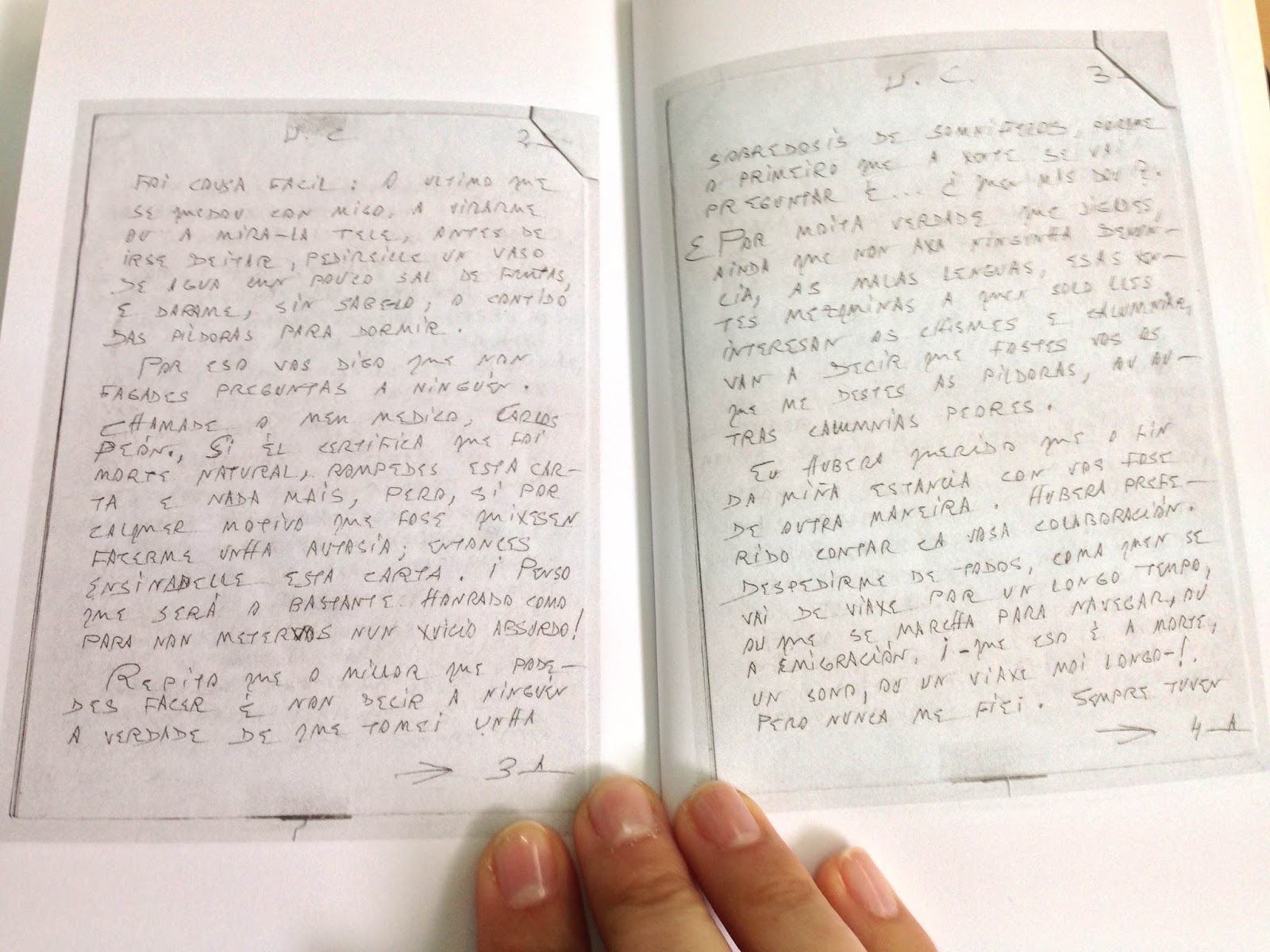
And of course a picture of his beautiful handwriting (he wrote with a pen in his mouth)

Letters in Music: "Madame"

Monique Andrée Serf (1930-1997) dite Barbara est une auteur-compositeur-interprète français. Je ne la connaissais pas, mais Dolores López m'a parlé de sa musique cette semaine et j'ai bien aimé ses belles chansons, sa poésie engagée, la beauté mélodique de ses compositions et la profondeur de l’émotion que dégageait sa voix.

"Dis, quand reviendras-tu?", "Nantes", "La Dame brune" (avec Georges Moustaki), "L'Aigle noir", "Ma plus belle histoire d'amour" sont des chansons sensibles et intimistes. Ici "Madame" (1970), une chanson sur la correspondance douloureuse, émouvante, avec une grande force émotionnelle.


"Madame"

Je reçois, à l'instant où je rentre chez moi
Votre missive bleue, Madame.
Vingt fois je la relis, et mes yeux n'y croient pas.
Pourtant, c'est écrit là, Madame
Et de votre douleur, je me sens pénétrée
Mais je ne pourrais rien, Madame.
Vous savez, aujourd'hui, que de l'avoir perdu,
C'est lourd à supporter, Madame.

Vous demandez pardon de n'avoir pas compris
Ce qu'était notre amour, Madame.
Vous n'aviez que ce fils, vous aviez peur de lui
Et vous l'avez gardé, Madame.
Ne me demandez pas ce qu'a été ma vie
Quand vous me l'avez pris, Madame.
Je me suis toujours tu, ce n'est pas aujourd'hui
Que je vous le dirais, Madame.
Vous eussiez préféré, je vous retrouve là,
Qu'il fût mort en héros, Madame.
Oui, c'eût été plus noble, je vous crois,
Que de mourir d'amour, Madame
Mais qu'il soit mort ici ou qu'il mourût là-bas,
Auriez-vous versé moins de larmes ?
Il en a décidé, lui seul avait le droit.
Il faut vous résigner, Madame.

C'est trop tard, maintenant, pour que je vous revienne
Et vous vieillirez seule, Madame
Et ne m'en veuillez pas si je parais cruelle
Mais je l'ai trop aimé, Madame
Pour qu'à la fin du jour, près d'une cheminée,
Nous évoquions ensemble, Madame,
Celui que, vous et moi, nous avons adoré
Et perdu tout ensemble, Madame

Mais le chagrin m'égare, il faut me pardonner.
J'ai mal de votre mal, Madame
Mais que faire, et quoi dire, puisqu'il s'en est allé ?
Je ne puis rien pour vous, Madame.
Pour la seconde fois, il va nous séparer.
Non, je ne viendrai pas, Madame,
Car, le perdre deux fois, c'est lourd à supporter.
Vous me comprendrez bien, Madame.

Je reçois, à l'instant où je rentre chez moi,
Votre missive bleue, Madame.
Vingt fois je la relis, et mes yeux n'y croient pas.
Pourtant, c'est écrit là, Madame
Et de votre douleur, je me sens pénétrée
Mais je ne puis plus rien, Madame.
Vous saurez, comme moi, que de l'avoir perdu
C'est lourd à supporter, Madame

Writing in Poems: Miro Villar (II)

Another poem today by Miro Villar, also from his latest book, As Crebas, dealing with writing and technology. It uses José Saramago's poem as a basis, which is nostalgic of paper books and praises them for their ability to function as containers of our sadness. In fact, both poems make me reminisce of Psalms 56:8, where the writer asks God: "save my tears in your bottle". In the same way, the pages of a book can save our tears - which cannot be said of  a technological device, since not only is it unable to save tears, but they can make it stop functioning altogether.

However, Miro's poem claims Saramago was inaccurate, because despite having all these new devices and technology, the problems we face and the feelings we experience throughout our lives continue to be the same.

Here you have the original poem and my attempt at a decent translation.

Escrita automática

"É ainda possível chorar sobre as páginas
de um livro, mas nao se pode derramar
lágrimas sobre um disco rígido"
José Saramago, (s.d.)

Derramabas bagullas a escorrer polos dedos e inundar
o teclado, maldita pianola de músicas perversas que
acompaña o ruído do diálogo aberto para o esquecemento.

Mentía Saramago pois non só se retorcen as páxinas con 
manchas de sangrada humidade, velaí as unllas
longas azuladas no sal, paxaros picapeixes nas augas atoldadas.

Automática escrita, cibernético envío, mecánica resposta,
a dor faise moderna, procura novos traxes, mais cando
abres xanelas é a mesma dor, a mesma dos xoguetes da 
infancia que rompen en anacos, das fraternais pelexas, da
dura adolescencia, da morte dos avós.


Automated Writing

You shed tears which slide down your fingers and flood
The keyboard, damn player piano of perverse music which
Accompanies the noise of an open dialogue ready to be forgotten.

Saramago lied, since not only do the pages twist with
Stains of bleeding wetness, but also the long
Bluish nails sink in the salt like kingfishers in the clouded waters.

Automated writing, cybernetic delivery, mechanic reply,
Pain becoming modern, looking for new costumes; but when
You open windows, it’s the same old pain, the same pain of
Childhood toys broken into pieces, of sibling fights, of
Hard adolescence, of the death of grandparents.

Friday, April 22, 2016

Postcrossing: Press Coverage

Yesterday Antón Parada, a journalist for La Voz de Galicia  interviewed both Luís Teira and myself to give readers some insight into Postcrossing and written correspondence nowadays. I thoroughly enjoyed the experience, Antón was very warm and enthusiastic about the subject and Luís was a perfect partner. 

I certainly hope the article published today motivates others to take up this heartwarming hobby.


Click here to read the article

Letters in Music: "Christmas Card from a Hooker in Minneapolis"

Foi Bea Muruais quen me introduciu a Tom Waits (1949) e a moitas outras músicas que descoñecía completamente antes de compartir pranta con ela  no Burgo de Nacións durante os anos de universidade, que daban para estudar e para moitas outras cousas igual de interesantes ou máis.

Coñecín a Tom Waits primeiro na súa faceta de actor, no filme Dracula (1992), onde facía de Renfield (lunático delirante)  bastante ben, por certo. E despois entrei a descubrir o seu talento musical. Bea foi facendo de "curator" da súa música, poñendo cancións en momentos escollidos e explicando as historias que se agochaban nelas: "November", "Just the Right Bullets", "Cinny's Waltz", "Somewhere", "Hope I Don't Fall in Love With You". 

O caso é que ou che encanta a voz de Waits ou non che gusta, non hai termo medio. De feito, Daniel Durchholz describiuna do seguinte xeito en Musichound Rock (traduzo): soa como se a "empaparas nun barril de whisky de Bourbon, a deixaras nun afumadoiro un par de meses, e despois a sacaras e a atropelara un coche". Pois iso. 

E aquí vos queda esta saturnina postal dunha prostituta en Minneapolis.


"Christmas Card from a Hooker in Minneapolis"
Hey Charley I'm pregnant
Living on 9th Street
Right above a dirty bookstore
Off Euclid Avenue
I stopped taking dope
And I quit drinking whiskey
And my old man plays the trombone
And works out at the track

He says that he loves me
Even though its not his baby
He says that he'll raise him up
Like he would his own son
He gave me a ring
That was worn by his mother
And he takes me out dancin'
Every Saturday night

Hey Charley I think about you
Every time I pass a fillin' station
On account of all the grease
You used to wear in your hair
I still have that record
Of Little Anthony and The Imperials
But someone stole my record player
How do ya like that?

Hey Charley I almost went crazy
After Mario got busted
I went back to Omaha
To live with my folks
Everyone I used to know
Was either dead or in prison
So I came back to Minneapolis
This time I think I'm gonna stay

Hey Charley I think I'm happy
For the first time since my accident
I wish I had all the money
That we used to spend on dope
I'd buy me a used car lot
And I wouldn't sell any of 'em
I'd just drive a different car every day
Dependin' on how I feel

Hey Charley, for chrissakes
Do you want to know the truth of it?
I don't have a husband
He don't play the trombone
I need to borrow money
To pay this lawyer
And Charley, hey
I'll be eligible for parole
Come Valentine's Day

Letters in Painting: A Girl Writing

Enfant écrivant by Henriette Browne
Henriette Browne (1829-1901) was a French Orientalist painter who was also one of the three female founder members of the Société Nationale des Beaux-Arts in Paris in 1862. 

In this painting, she chooses a young girl who is writing a letter or doing homework but gets distracted by a little bird. I love the light focusing on her neckline.