Tuesday, May 3, 2016

Letters in Poems: The Letter

There are many rituals of letter-writing: from the selection of stationery and writing instruments to the actual act of writing, mailing, the delivery, the reading, inevitable re-readings and the storing as keepsakes. A really complex, multifaceted ritual which digital communication can never give us. And rituals are important in our lives, since they allow us to pay more attention to what we are doing and give us space to be more creative.

Charlotte Brontë (1816-1855) wrote a lovely poem where she described in vivid detail the writing of a letter. The poem is structured in 3 main parts. The first 3 stanzas paint a detailed scene of a young woman writing a letter at her desk on a summer evening: anxiety, eagerness, total absorption. She is totally focused on the words flowing from her and onto the pages. The 4th stanza in the middle is the transition, where Brontë tells the readers where to focus their attention. Finally, the last 3 stanzas move our gaze to the recipient of the letter.


The Letter 
 

WHAT is she writing? Watch her now,
How fast her fingers move!
How eagerly her youthful brow
Is bent in thought above! Her long curls, drooping, shade the light,
She puts them quick aside,
Nor knows that band of crystals bright,
Her hasty touch untied.
It slips adown her silken dress,
Falls glittering at her feet;
Unmarked it falls, for she no less
Pursues her labour sweet.

The very loveliest hour that shines,
Is in that deep blue sky;
The golden sun of June declines,
It has not caught her eye.
The cheerful lawn, and unclosed gate,
The white road, far away,
In vain for her light footsteps wait,
She comes not forth to-day.
There is an open door of glass
Close by that lady's chair,
From thence, to slopes of messy grass,
Descends a marble stair.

Tall plants of bright and spicy bloom
Around the threshold grow;
Their leaves and blossoms shade the room
From that sun's deepening glow.
Why does she not a moment glance
Between the clustering flowers,
And mark in heaven the radiant dance
Of evening's rosy hours?
O look again! Still fixed her eye,
Unsmiling, earnest, still,
And fast her pen and fingers fly,
Urged by her eager will.

Her soul is in th'absorbing task;
To whom, then, doth she write?
Nay, watch her still more closely, ask
Her own eyes' serious light;
Where do they turn, as now her pen
Hangs o'er th'unfinished line?
Whence fell the tearful gleam that then
Did in their dark spheres shine?
The summer-parlour looks so dark,
When from that sky you turn,
And from th'expanse of that green park,
You scarce may aught discern.

Yet, o'er the piles of porcelain rare,
O'er flower-stand, couch, and vase,
Sloped, as if leaning on the air,
One picture meets the gaze.
'Tis there she turns; you may not see
Distinct, what form defines
The clouded mass of mystery
Yon broad gold frame confines.
But look again; inured to shade
Your eyes now faintly trace
A stalwart form, a massive head,
A firm, determined face.

Black Spanish locks, a sunburnt cheek
A brow high, broad, and white,
Where every furrow seems to speak
Of mind and moral might.
Is that her god? I cannot tell;
Her eye a moment met
Th'impending picture, then it fell
Darkened and dimmed and wet.
A moment more, her task is done,
And sealed the letter lies;
And now, towards the setting sun
She turns her tearful eyes.

Those tears flow over, wonder not,
For by the inscription see
In what a strange and distant spot
Her heart of hearts must be!
Three seas and many a league of land
That letter must pass o'er,
Ere read by him to whose loved hand
'Tis sent from England's shore.
Remote colonial wilds detain
Her husband, loved though stern;
She, 'mid that smiling English scene,
Weeps for his wished return.

From Hand to Heart: As mans na fotografía de Xurxo Lobato


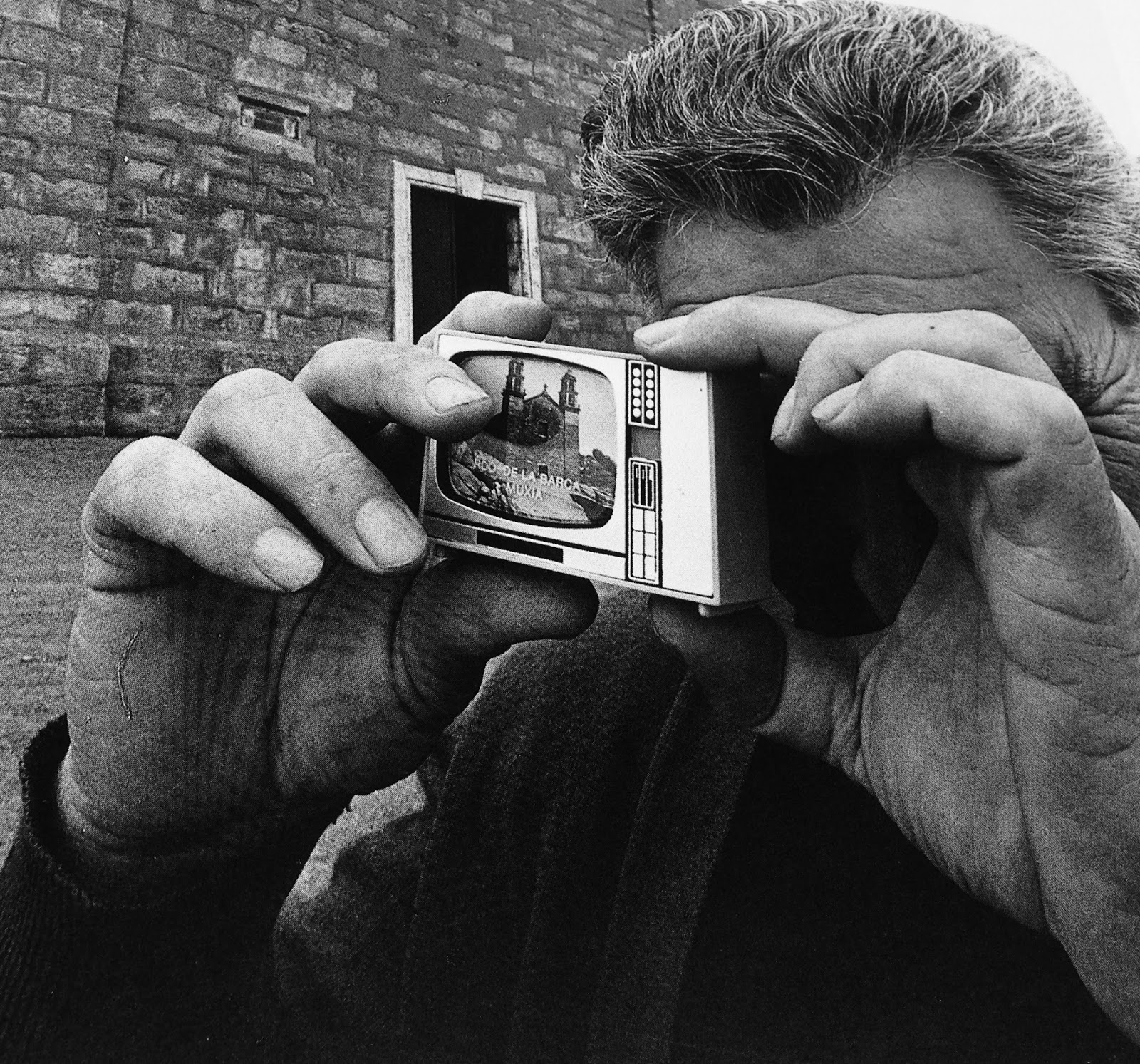
El fin de Finisterre. Viaje a Costa da Morte (1991) é un libro con poemas de César Antonio Molina e fotografías de Xurxo Lobato.  Como se indica no prólogo, “É na costa da Morte onde a terra se asoma ao mar dun xeito tan desafiante e tan poderoso que só desde unha perspectiva poética de tinturas en boa parte épicas se podería intentar expresar esta beleza, esta enerxía creadora e destructora, en resumo esta magnificencia natural” . Sen caer na Galicia tópica, folclorizante e tebrista, ámbolos dous retratan espazos, xentes e cousas do mundo mariñeiro e rural pra presentar unha visión complexa, profunda e harmónica.

Déixovos unha selección de fotografías de Lobato e algúns poemiñas de Molina, pero merece a pena botar unha ollada ao libro.


XALLAS

Polas túas augas
ás veces baixa un pensativo afogado
que se lanza desde o cume ata o máis alto.

CABO VILÁN

Todo un exército de alfís
comidos pola túa luz.


NORDESÍA

As miñas cinzas
libres ao fin do teu amor.

Tamén atopades este libro na Biblioteca Pública Municipal Victoriano García Martí.

Monday, May 2, 2016

Postcards in Books: Si tuviera que escribirte

Hai regalos que emocionan, por inesperados, porque son unha caricia suave do corazón, porque alguén pensou en ti un día calquera (menudo luxo!) e soubo que ese pequeno detalle che ía gustar.

Velaquí un deses agasallos memorables, que é especial non só porque me encanta, senón tamén porque non quedará para min, irase descompoñendo en anaquiños e viaxando cara outras mans agradecidas.

Trátase de Si tuviera que escribirte (2015) de Alejandra Correa. Alejandra é unha poeta e artista visual uruguayo-argentina, e esta colección de postais contén a seguinte descripción: 

¿De qué formas podemos decir el amor? La carta ha sido a través del tiempo una manera de dejar testimonio sobre la maravilla, la duda, el deseo y el dolor que ha dado al mundo el amor. En esta serie de postales, la poeta y artista visual Alejandra Correa y Libros de las Malas Compañías proponen un dispositivo amoroso para darle cuerda a los días.

A primeira das 28 postais contén as instrucións para dar corda ao dispositivo amoroso, proporcionando catro movementos: 1) elixir a un ou máis destinatarios (seleccionados por cercanía, conveniencia ou méritos pessoais); 2) elaborar un plan para o envío (unha postal por día; unha por semana; unha por ano; entregar as 28 á vez a un só amor ou unha a 28 amores diferentes); 3) elixir unha forma de envío (por correo, anónimas, con seudónimo, por debaixo da porta, en sitios públicos); 4) quedar con elas e non envialas, senón ler unha delas cada día.


Gústavos o xogo? Pois está a piques de comezar!

Mil grazas por este marabilloso agasallo.

Letters in Photographs: Kusakabe Kimbei

Writing Letter (also known as Letter Writer) by Kusakabe Kimbei

Kusakabe Kimbei (日下部 金兵衛) (1841–1934) was a Japanese photographer. In 1854, Japan opened its doors to the outside world for the first time in more than 200 years, which set in motion a truly astounding transformation. As fate would have it, photography had just been invented, and as the old country vanished and the new one was born, daring photographers such as Kusakabe Kimbei took photos.


This interesting web site is a depository of old photos of Japan and it provides a detailed description of each one of them. I am pasting below the description for Writing Letter (or Letter Writer).

"A woman wearing a kimono is writing a letter with a brush. A box to place brushes and sumi (ink), and an andon lamp are on the tatami (rice mats). In the back hangs a kakejiku(hanging scroll).

The Japanese writing system was introduced to Japan from China in the 4th century AD. Initially, the Chinese characters were only used for reading and writing Chinese. Around the mid seventh century, or possibly earlier, a writing system was developed which used Chinese characters to represent the Japanese language. This was called Manyogana (万葉仮名). The name has been derived from the Manyoshu, a Japanese poetry anthology from the Nara Period (710-794).

The Meiji Period (1868-1912) saw a range of important transformations in the use of written Japanese. The Genbunitchi (言文一致) movement, for example, resulted in using a colloquial form to write. Previously, a classical style had been used. Additionally, in 1900, the Education Ministry standardized the hiragana script and limited the number of kanji (Chinese characters) taught in elementary schools to about 1,200.

More significant reform followed after the end of WWII, when conservatives were removed from control of the educational system. Undoubtedly, the most important reforms were limiting the number of kanji students learn at Japanese high-schools to just 1,850, and changing the direction from right-to-left to left-to-right."

I am thankful to Noriko Fukushima for her wonderful workshop about Japanese calligraphy in our school, and to Miro Villar for letting me know about Kusakabe Kimbei and this beautiful photograph.

Handwriting in Books: Argüelles. Muller e mar

Argüelles, Muller e Mar. Antoloxía poética (2001) is a captivating, heartfelt collection of linoleum engravings by Julio A. Fernández Argüelles (1923-2002), who calls himself in the presentation “mariño por destino” and indicates that he found justification and motivation for his work in the sea. Each engraving is accompanied by a copy of a handwritten poem by a Galician poet.

I am leaving you here a selection of my favourites. As an introduction to these photographs, here goes an excerpt from the preface by Alfredo Conde (1945):


“As páxinas que seguen, ocupadas por gravados e poemas que din do mar e da muller, dinnos tamén dos altos mastros e das vellas fasquías dos paquebotes, do lento navegar dos candrais e os transatlánticos, dos tramps e as longas e douradas singraduras que xa nunca máis han ser posibles. Nin hai paquebotes e a penas haberá gavotas nos gravados de Julio Argüelles, pero están aí, do gravado no seu ángulo máis escuro, se é que se nos consinte parafrasea-lo verso, esperando as mans de neve que avisen da súa existencia. Esas mans teñen dedos coma versos, acaso versos coma dedos, quen o sabe, cos que nos agarima-la pel da alma e suxerir solucións para esa ecuación de muller e mar, de mar e muller, que se cumpre para tantas e tantas variables como os poetas acorden presentar posibles”.


Sunday, May 1, 2016

Letters in Books: O wolframio en Varilongo. Santa Comba de Xallas (1941-1963)

Hai unha semana, presentouse o libro O volframio en Varilongo. Santa Comba de Xallas (1941-1963) (2016) de Carmen Blanco Ramos, (1957) escritora coñecida pola súa novela A golpe de dor (2002) e orixinaria de Vilar de Céltigos, aldea próxima a Varilongo, no cal explora o universo mineiro do tungsteno ou volframio (wolfram). Alén do traballo de investigación, Blanco achega a dimensión persoal cos testemuños que recolliu de vintetrés persoas a través de entrevistas.

O libro desenvólvese en nove capítulos: os primeiros contextualizando a importancia do volframio para os alemáns na Segunda Guerra Mundial, a descuberta das primeiras pedras do “axio mouro”, a “roubeta”, o asentamento da Compañía Mineira Celta e as formas de explotación. No capítulo IV recóllese a visión dos informantes sobre os presos antifranquistas mentres o V e VI se centran na familia Liste e o banqueiro Ildefonso Fierro. O VII busca explicar os motivos da caída do prezo do volframio. E como colofón ten dous preciosos capítulos que abordan a pegada literaria da mina, o IX a través das “cantareas” ou poesía popular de transmisión oral e o X a través da narrativa culta.

O capítulo V, que como diciamos, se centra nos seis Liste que traballaron na mina de Santa Comba, ábrese co seguinte soneto de Antonio Machado (p.77):

A Líster, jefe en los ejércitos del Ebro

Tu carta – oh noble corazón en vela,
español indomable, puño fuerte-,
tu carta, heroico Líster, me consuela
de esta, que pesa en mí, carne de muerte.

Fragores en tu carta me han llegado
de lucha santa sobre el cambo ibero;
también mi corazón ha despertado
entre olores de pólvora y romero.

Donde anuncia marina caracola
que llega el Ebro, y en la peña fría
donde brota esa rúbrica española,

de monte a mar, esta palbra mía:
“Si mi pluma valiera tu pistola
de capitán, contento moriría”.

Seguro que moitos veriades o filme Lobos sucios (2016), do que vos deixo o trailer, pero paga a pena ler o libro para afondar na historia do volframio en Galicia e descubrir como os alemáns, ao verse limitado o seu acceso ao “ouro negro” de China durante a Segunda Guerra Mundial, puxeron a súa ollada en Europa, en concreto na Península Ibérica onde se atopaba o 95% da produción europea de volframita, para abastecerse e construír obuses perforantes, tornos e chapas acoirazadas.  Ademais, a mina de Varilongo é a gran descoñecida, como Blanco indica na introducción: “Se as minas de Fontao e as de Noia serviron de escenario a escritores e investigadores, as de Santa Comba, a pesar de seren as minas máis importantes en produción de volframio entre 1962-1963, carecen dun narrador e dun mínimo estudo” (p.20).


Varilongo é tamén parte da miña historia persoal pois o meu avó José Pastoriza traballou na mina, se ben brevemente, xa que despois emigrou. Meu pai recorda que efectivamente, como se mostra no libro e no filme,  era común a “roubeta” e que o avó trouxese anacos do wolfram na bolsa da comida para logo vender e sacar unhas pesetas.


Debo agradecer a Miguel Conde, alumno meu hai uns anos, que me falase das minas en detalle, pois aínda que as vira e algunhas historias me contaran, descoñecía que o mineral ía para o estado alemán e para fins bélicos.

E por último, xa vedes que o martes 3 de maio ás 20:00 como parte da feira do libro de Santiago deste ano,  podedes escoitar á autora presentando este libro.


Letters in Films: Incendies


Incendies (2010) est un drame réalisé par Denis Villeneuve et coproduit par la France et le Québec basé sur la célèbre pièce de théâtre éponyme de Wajdi Mouawad (1968).

Voice l'histoire: Lorsque le notaire Lebel fait à Jeanne et Simon Marwan (Mélissa Désormeaux-Poulin et Maxim Gaudette) la lecture du testament de leur mère Nawal (Lubna Azabal), les jumeaux sont sidérés de se voir remettre deux enveloppes, l'une destinée à un père qu’ils croyaient mort et l’autre à un frère dont ils ignoraient l’existence. Jeanne voit dans cet énigmatique legs la clé du silence de Nawal, enfermée ces dernières années dans un mutisme obstiné depuis son lit d’hôpital. Elle décide immédiatement de partir au Moyen-Orient exhumer le passé de cette famille dont elle ne sait presque rien...

Le jeune Simon, lui, n'a que faire des caprices posthumes de cette mère avare d'affection qui a passé sa vie à leur empoisonner l'existence. Mais son amour pour sa soeur le poussera bientôt à rejoindre Jeanne au Moyen-Orient sur la piste d'une Nawal bien loin de la mère qu'ils ont connue...